
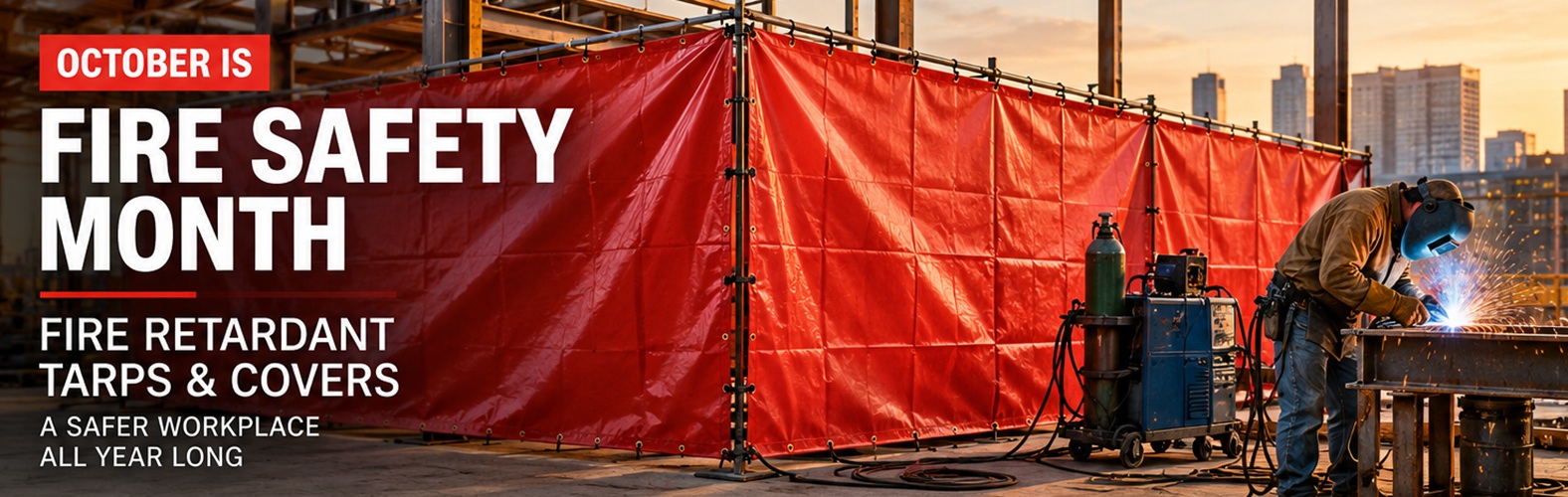
October is widely recognized as Fire Prevention Month, making it a good time for homes, businesses, construction companies, manufacturers, and other organizations to review fire safety practices. Fire Prevention Week is observed during the week containing October 9, a tradition connected to the Great Chicago Fire of 1871. In 2026, Fire Prevention Week runs October 4–10.
Fire safety is not limited to smoke alarms and fire extinguishers. In commercial, industrial, construction, and maintenance settings, it also means looking at the materials being used around heat, sparks, welding operations, equipment, temporary enclosures, and active work areas.
Fire Retardant Tarps and Covers can be an important part of this approach.
These specialized products are available in Vinyl, Poly, Canvas, Mesh, Poly Sheeting, Debris Netting, Industrial Curtain materials, and other fabrics. They can be used to cover equipment and materials, create temporary barriers, contain work areas, and support safer welding and construction operations.
Fire Safety Is a Year-Round Concern
October puts added attention on fire prevention, but the numbers show why fire safety deserves consideration throughout the year.
According to the National Fire Protection Association (NFPA), local fire departments responded to an estimated 1.388 million fires in the United States during 2024. Those fires caused an estimated 3,920 civilian deaths, 11,780 civilian injuries, and $19 billion in direct property damage. That works out to a fire department responding to a fire somewhere in the United States about every 23 seconds.
Businesses and industrial facilities face their own risks. NFPA reports that from 2020 through 2024, U.S. fire departments responded to an estimated average of 1,544 warehouse structure fires each year. Shop tools and industrial equipment were involved in the ignition of 19 percent of these fires.
Construction sites also require active fire prevention. OSHA states that employers are responsible for developing and maintaining an effective fire protection and prevention program throughout construction, repair, alteration, and demolition work.
This is where choosing appropriate materials can become part of a larger fire safety plan.
What Is a Fire Retardant Tarp?
A Fire Retardant Tarp is made from material designed or treated to resist ignition and reduce or slow flame propagation compared with ordinary untreated material.
It is important to understand that fire retardant does not mean fireproof. A Fire Retardant Tarp can still be damaged or consumed by enough heat or direct flame. Its purpose is to provide improved flame resistance according to the properties and testing of the specific material.
Common standards commonly associated with Tarp, curtain, film, and fabric materials include NFPA 701, CPAI-84, ASTM E 84 (Class A), and California State Fire Marshal F-121.2.
Always check the specifications and certification for the exact material being purchased. Local fire codes, building requirements, job specifications, and workplace regulations can vary by application.
Fire Retardant Tarps and Covers for Different Applications
There is no single Fire Retardant Tarp that is best for every situation. The environment and job should determine the material.
Fire Retardant Vinyl Tarps provide a durable, waterproof covering for construction, industrial, manufacturing, transportation, and commercial applications. Vinyl and Clear Vinyl are useful choices when strength, weather protection, and flame-retardant properties are needed together.
Fire Retardant Poly Tarps offer a lighter-weight option. They are useful for temporary covers, equipment protection, material protection, jobsite applications, and general outdoor use where an FR-rated covering is required.
Fire Retardant Canvas Tarps combine the familiar handling characteristics of canvas with flame-retardant treatment. Canvas can work well around machinery, equipment, maintenance areas, construction projects, and industrial environments.
Fire Retardant Mesh Tarps provide airflow while helping create barriers, screens, and enclosures. They can be useful for construction sites, scaffolding, industrial facilities, events, and other locations where ventilation is important.
Fire Retardant Salvage Covers and Tarps can help protect floors, equipment, furnishings, and other property. These covers are particularly useful for maintenance, restoration, emergency response, and work taking place inside occupied buildings.
Fire Retardant Containment Tarps help isolate work zones and create temporary enclosures. Applications can include construction, renovation, demolition, dust control, painting, blasting, and industrial maintenance.
Fire Retardant Poly Sheeting provides another flexible option for temporary walls, barriers, enclosures, equipment protection, and construction containment. Reinforced options can add strength for more demanding installations.
Fire Retardant Netting for Construction and Scaffolding
Construction projects often need protection without completely enclosing the work area.
Fire Retardant Debris Netting can help contain small debris while providing a more open structure than solid Tarp material. It is commonly used around building projects, renovations, demolition areas, and elevated work.
Scaffold Sheeting Tarps is designed for scaffolding systems and building exteriors. It can help with debris containment, work-zone separation, and jobsite organization while still allowing airflow.
Fire-retardant materials can be especially important in temporary construction arrangements. NFPA materials addressing construction fire protection discuss flame-resistant tarpaulins and plastic films and reference NFPA 701 testing for these materials.
Welding Blankets and Hot Work Safety
Welding, cutting, grinding, and other hot work introduce another type of fire hazard.
Sparks, slag, and heat can travel beyond the immediate work area and reach nearby combustible materials. OSHA requires precautions when welding, cutting, or heating cannot be separated from surrounding fire hazards. OSHA rules call for measures to confine heat, sparks, and slag and protect hazards that cannot be moved. Suitable fire extinguishing equipment must also be immediately available.
Welding Blankets can be used as part of this type of protection. Depending on their material and temperature rating, they may help shield equipment, floors, machinery, walls, and surrounding areas from sparks, spatter, and heat.
A Welding Blanket should always be selected according to the specific welding process, expected temperature, exposure, and manufacturer specifications. It is not a substitute for required fire watches, extinguishers, removal of combustible materials, or other hot-work procedures.
Fire Retardant Industrial Curtains
Fire Retardant Custom Industrial Curtains provide a flexible way to divide large spaces.
Warehouses, factories, maintenance departments, auto facilities, fabrication shops, and production plants can use curtains to separate work zones without constructing permanent walls.
Depending on the material and design, Industrial Curtains can be used for:
- Work area separation
- Temporary partitions
- Production and maintenance areas
- Dust and overspray control
- Equipment isolation
- Welding and fabrication zones
Fire Retardant Industrial Curtains can be especially valuable when a facility requires flexible space management but also needs materials with appropriate flame-retardant properties.
Custom Fire Retardant Tarps
Standard sizes work for many projects, but not every machine, work zone, enclosure, or structure has standard dimensions.
Fire Retardant Custom Tarps can be manufactured to fit a particular application. Depending on the material and design, customization may include specific dimensions, grommet placement, D-rings, reinforced edges, webbing, Velcro, openings, or other attachment features.
Custom Tarp fabrication is useful for equipment covers, machinery, temporary enclosures, partitions, industrial applications, construction projects, and unusual shapes or dimensions.
Fire Retardant Fabric by the Yard and Roll provides another option for companies that make their own covers, curtains, barriers, liners, or specialized components. Buying FR Tarp Material in bulk can be particularly useful for manufacturers, contractors, maintenance operations, and fabricators.
Industries That Benefit from Fire Retardant Tarps and Covers
Fire Retardant Tarps and Covers serve many industries. Some of the most common include construction and demolition, manufacturing, welding and metal fabrication, warehousing, industrial maintenance, utilities, transportation, automotive operations, aerospace, shipyards and marine operations, oil and gas facilities, entertainment and event production, schools and universities, government facilities, emergency services, and restoration companies.
Each industry has different hazards. A welding shop may need Welding Blankets and Industrial Curtains. A construction contractor may need FR Poly Tarps, Scaffold Debris Netting, or Containment Tarps. A manufacturer may need Custom Equipment Covers and curtain systems.
The key is matching the product to the actual hazard and application.
Make Fire Safety Part of the Routine
Fire Prevention Month is a useful reminder to inspect more than fire extinguishers and alarms.
Businesses can also review temporary enclosures, covers, curtains, welding areas, stored materials, ignition sources, emergency exits, and housekeeping practices. Workplace fire prevention plans should address major fire hazards, fuel sources, ignition sources, combustible waste, and the equipment needed to control identified hazards.
For Tarps and Covers, a simple inspection can include checking:
- Is the material appropriate for the job and environment?
- Does the application require a tested or certified fire-retardant material?
- Are covers and curtains damaged, excessively worn, or contaminated?
- Are FR labels and certifications available when required?
- Are hot-work areas properly separated from combustible materials?
- Are exits, extinguishers, sprinklers, and other safety equipment unobstructed?
Fire Retardant Tarps should be one component of a complete safety program, not a replacement for proper training, fire prevention procedures, alarms, extinguishers, sprinklers, fire watches, or emergency planning.
A Practical Layer of Fire Protection
October's focus on fire prevention is a good opportunity to look around the jobsite, warehouse, factory, workshop, or facility and identify areas where better protection may be needed.
Fire Retardant Vinyl Tarps, Poly Tarps, Canvas Tarps, Mesh Tarps, Salvage Covers, Containment Tarps, Poly Sheeting, Debris Netting, Scaffold Netting, Welding Blankets, Industrial Curtains, Custom Tarps, and FR Fabric by the Yard or Roll provide many options for different environments.
Choosing the right material can help protect equipment, supplies, structures, work zones, and surrounding areas while supporting a broader fire prevention program.
Fire safety is ultimately about preparation. Using appropriate Fire Retardant Tarps and Covers is one practical step businesses and contractors can take to create safer, better-prepared work environments during Fire Prevention Month, and throughout the year.
If you have questions or need assistance with any of our products including Fire Retardant Tarps, please contact Tarps Now at (888) 800-1383 or sales@tarpsnow.com where a knowledgeable and helpful team member located at our Michigan headquarters looks forward to speaking with you.
