
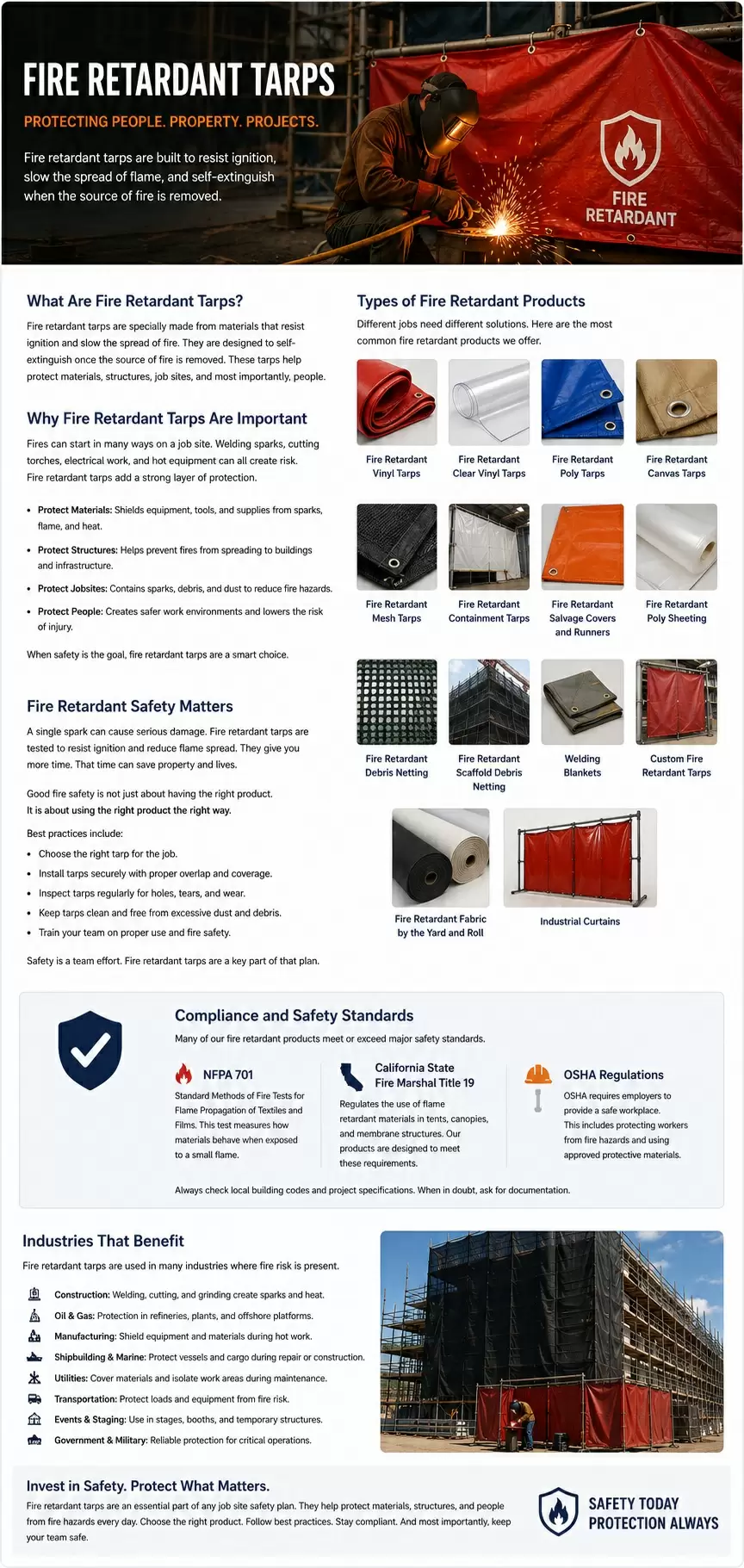
Fire safety is important on construction sites, in factories, at warehouses, around temporary structures, and anywhere that heat, sparks, or open flames may be present. A small spark from welding, grinding, cutting, electrical equipment, or hot machinery can quickly damage materials, structures, and equipment.
Fire Retardant Tarps, Fire Resistant Tarps, and Flame Retardant Tarps provide an added level of protection in demanding settings. They are made from specially treated or engineered materials that resist ignition and help slow the spread of flames.
These Tarps can cover equipment, divide work areas, contain debris, protect surfaces, and form temporary barriers. They are available in many fabrics, Material weights, sizes, colors, and configurations. Custom options can also be produced for equipment, structures, work zones, and unusual applications.
What Are Fire Retardant Tarps?
Fire Retardant Tarps are protective covers manufactured to meet specific flame resistance or flame propagation testing requirements. Some use material that naturally handles heat well. Others are treated with a flame-retardant process during manufacturing.
The terms fire retardant, fire resistant, and flame retardant are often used interchangeably. However, they do not necessarily mean that a product is fireproof. A Fire Retardant Tarp is designed to resist ignition, limit flame spread, or self-extinguish after the ignition source is removed, depending on its material and tested rating.
Product specifications should always be reviewed before selecting a Tarp. The correct choice depends on the heat source, work environment, expected exposure, local regulations, and project requirements.
Why Fire Retardant Tarps Are Important
Fires can begin in many ways. Welding sparks can travel beyond the immediate work area. Grinding and cutting can send hot particles toward nearby surfaces. Temporary heaters, damaged electrical cords, generators, and hot equipment can also create risks.
Fire Retardant Tarps help businesses create safer and more controlled working environments. Depending on the product and installation, they can help:
- Shield equipment, supplies, and building materials from sparks and heat
- Separate hot work from nearby employees and operations
- Reduce the chance of flames spreading across a protective cover
- Contain dust, debris, paint, blasting material, and other project waste
- Protect floors, walls, machinery, vehicles, and finished surfaces
- Support workplace safety procedures and project requirements
These products are not a replacement for fire extinguishers, sprinklers, alarms, fire watches, employee training, ventilation, or safe hot-work procedures. They are one part of a complete fire-prevention and workplace safety plan.
Popular Fire Retardant Tarp Products
Different jobs require different materials. A lightweight temporary cover may work well for one project, while another operation may require a heavy duty Vinyl Tarp barrier or a high-temperature Welding Blanket.
Fire Retardant Vinyl Tarps
Fire Retardant Vinyl Tarps provide strong protection for demanding indoor and outdoor applications. Vinyl is waterproof and resists abrasion, tearing, mildew, and UV exposure easily adapting to common jobsite conditions.
These Tarps are often used as equipment covers, construction enclosures, industrial barriers, truck covers, machinery covers, and weather protection. Their strength makes them a good choice for repeated or long-term use.
Fire Retardant Clear Vinyl Tarps
Fire Retardant Clear Vinyl Tarps provide protection without blocking visibility. Workers can observe equipment, production areas, and work zones through the material.
Clear Vinyl Tarps and Curtains are useful for industrial partitions, loading docks, temporary rooms, warehouse barriers, washdown areas, and outdoor enclosures. They can also help control weather, dust, and overspray while keeping work areas visible.
Fire Retardant Poly Tarps
Fire Retardant Poly Tarps are lightweight, waterproof, and easy to handle. They are commonly selected for temporary protection when fast installation and easy removal are important.
These can cover equipment, supplies, building materials, roofs, walls, floors, and outdoor storage. Their lower weight also makes them convenient for emergency response, maintenance, remodeling, and short-term construction projects.
Fire Retardant Canvas Tarps
Fire Retardant Canvas Tarps provide durable protection while allowing more air movement than many plastic materials. Their breathability can help reduce trapped moisture and condensation around certain equipment and supplies.
Canvas Tarps are often used over machinery, tools, building materials, agricultural equipment, and industrial supplies. They are also useful where a less slippery or more traditional fabric surface is preferred.
Fire Retardant Mesh Tarps
Fire Retardant Mesh Tarps allow air and some light to pass through while helping provide shade, privacy, wind reduction, and containment. Their open weave places less wind pressure on fences and structures than a solid Tarp.
Common uses include fence screens, privacy barriers, scaffold protection, outdoor work areas, shade covers, and industrial enclosures.
Fire Retardant Containment Tarps
Fire Retardant Containment Tarps help isolate work from surrounding areas. They may be installed around renovation, demolition, painting, sandblasting, welding, concrete, or maintenance operations.
A containment system can help control debris, dust, overspray, sparks, and other project materials. It can also keep nearby workspaces cleaner and more organized.
Fire Retardant Salvage Covers and Runners
Salvage Covers and Tarps protect furniture, machinery, flooring, equipment, and stored goods during emergencies, restoration work, maintenance, and construction. These covers can be placed over floors and walkways to protect against dirt, moisture, dust, sparks, and foot traffic. These products are useful for fire departments, restoration contractors, schools, hotels, hospitals, offices, and public buildings.
Fire Retardant Poly Sheeting
Fire Retardant Poly Sheeting is supplied in rolls and can be cut to fit a wide range of spaces. It is used to build temporary walls, partitions, dust barriers, equipment covers, and containment areas.
Contractors often use Fire Retardant Poly Sheeting during remodeling, restoration, construction, asbestos or lead-related containment, and industrial maintenance. Installation methods should follow the project plan and applicable safety requirements.
Fire Retardant Debris Netting
Fire Retardant Debris Netting helps contain lightweight debris and dust while still allowing airflow. It can be attached to fences, buildings, scaffolding, and temporary structures.
The netting can help protect workers, pedestrians, vehicles, neighboring property, and public areas. It also improves jobsite appearance and helps keep loose materials within the work zone.
Fire Retardant Scaffold Debris Netting
Fire Retardant Scaffold Debris Netting is designed for installation around scaffolding and building exteriors. It helps prevent small debris from leaving elevated work areas while providing a more controlled space for workers.
It is commonly used during masonry work, façade repair, painting, demolition, restoration, and commercial construction. The netting must be properly secured and selected with wind loads, fastening methods, and scaffold requirements in mind.
Welding Blankets
Welding Blankets are designed for work involving sparks, slag, spatter, and elevated temperatures. They can be hung vertically as a barrier or placed over equipment and surfaces, depending on the product rating and intended use.
Welding Blankets help protect machinery, floors, vehicles, walls, and nearby materials during welding, grinding, cutting, brazing, and other hot work. The temperature rating and exposure type should always be matched to the operation.
Custom Fire Retardant Tarps
Standard sizes do not fit every project. Fire Retardant Custom Tarps can be made to cover specific machines, products, openings, structures, and work areas.
Custom options may include:
- Special lengths, widths, and shapes
- Reinforced hems and corners
- Grommets, D-rings, webbing, and straps
- Zippers, hook-and-loop fasteners, and access panels
- Clear windows, vents, sleeves, and cutouts
- Custom colors and material weights
A properly fitted cover can provide better coverage, easier installation, and less loose material around active equipment.
Fire Retardant Fabric by the Yard and Roll
Fire Retardant Fabric by the Yard and Roll gives contractors, manufacturers, maintenance teams, and fabricators the ability to create their own covers and barriers.
Available materials may include Vinyl, Clear Vinyl, Poly, Canvas, Mesh, and specialized high-temperature fabrics. Fabric rolls can be used for curtains, covers, partitions, liners, equipment wraps, repair sections, and original manufactured products.
Industrial Curtains and Fire Retardant Safety
Fire Retardant Industrial Curtains provide a flexible way to divide large work areas. Unlike permanent walls, Curtains can be opened, closed, moved, replaced, or reconfigured as operations change.
Industrial Curtain Systems can help separate welding, grinding, production, storage, painting, washing, and maintenance activities. Clear viewing panels can be added where visibility is needed. Tracks, rollers, floor attachments, and other hardware can create a complete operating system.
Curtains used near welding or other hot work must be suitable for the expected exposure. A standard flame-retardant divider is not automatically a substitute for a Welding Blanket or high-temperature shield.
Industries That Benefit from Fire Retardant Tarps
Fire Retardant Tarps are used in many industries where heat, sparks, temporary enclosures, valuable materials, or public safety must be considered.
- Construction: Covers, containment, scaffolding, renovation, and hot-work protection
- Manufacturing: Machinery covers, welding areas, production barriers, and maintenance zones
- Warehousing: Storage protection, partitions, equipment covers, and temporary workspaces
- Oil, Gas, and Energy: Maintenance barriers, equipment protection, and hot-work controls
- Marine and Shipbuilding: Welding, repair, painting, equipment protection, and containment
- Transportation: Vehicle maintenance, cargo protection, repair facilities, and terminals
- Utilities: Temporary barriers and protection during repair and maintenance
- Restoration: Salvage protection, temporary walls, floor runners, and debris containment
- Events and Entertainment: Stages, scenery, booths, curtains, and temporary structures
- Government and Military: Equipment covers, temporary facilities, maintenance, and emergency operations
Schools, hospitals, hotels, sports facilities, municipalities, and commercial property managers can also benefit from these protective materials.
Compliance and Fire Safety Standards
Fire Retardant Tarps may be tested or certified under different standards. The required standard depends on the material, location, industry, building code, fire authority, and intended application.
NFPA 701
NFPA 701 provides standardized test methods for evaluating flame propagation in certain textiles and films. It is frequently referenced for Curtains, Tarps, drapes, temporary enclosures, and related flexible materials.
NFPA 701 is a test standard. It does not mean that a material is fireproof, and it does not measure every possible fire condition. Buyers should confirm that the specific finished product has the documentation required for the intended use.
California State Fire Marshal Title 19
California Title 19 includes requirements relating to flame-retardant materials, treatments, registration, testing, and certification. California projects, public spaces, tents, decorative materials, and event applications may require documentation accepted by the California State Fire Marshal or local fire authority.
Requirements can vary by product and use. Always confirm current rules with the authority having jurisdiction before purchasing or installing the material.
OSHA Regulations
OSHA workplace rules address fire prevention, welding, cutting, hot work, worker protection, and the control of ignition hazards. OSHA may require combustibles to be removed or protected when welding and cutting cannot be moved to a safer location.
The correct Tarp, Curtain, Blanket, screen, or shield depends on the hazard. Employers remain responsible for evaluating the workplace, training employees, supplying suitable protective equipment, and following all applicable standards.
Fire Retardant Tarp Safety Tips
Even a properly rated product must be selected, installed, and maintained correctly. Follow the manufacturer’s instructions and the project safety plan.
- Confirm the product rating before use
- Match the material to the temperature and type of exposure
- Secure covers so sparks and hot debris cannot pass through gaps
- Keep Tarps away from direct flame unless specifically rated for that use
- Inspect the material for holes, tears, worn coatings, and damaged seams
- Keep exits, alarms, sprinklers, extinguishers, and ventilation clear
- Remove combustible dust and debris from the work area
- Maintain a fire watch when required
- Keep certificates and test documents available for inspection
Choose the Right Fire Retardant Protection
Fire Retardant Tarps provide valuable protection for materials, structures, jobsites, equipment, and people. They can help control sparks, separate work zones, cover valuable property, contain debris, and support safer operations.
The wide selection of Fire Retardant Vinyl Tarps, Clear Vinyl Tarps, Poly Tarps, Canvas Tarps, Mesh Tarps, Containment Tarps, Salvage Covers, Poly Sheeting, Debris Netting, Scaffold Netting, Welding Blankets, Industrial Curtains, Custom Tarps, and Fabric by the Yard or Roll makes it possible to match the protection to the project.
Before ordering, review the working conditions, flame exposure, dimensions, installation method, and required safety documentation. Choosing the correct product and using it properly can help protect what matters most.
If you have questions or need assistance with any of our products including Fire Retardant Tarps, please contact Tarps Now at (888) 800-1383 or sales@tarpsnow.com where a knowledgeable and helpful team member located at our Michigan headquarters looks forward to speaking with you.
